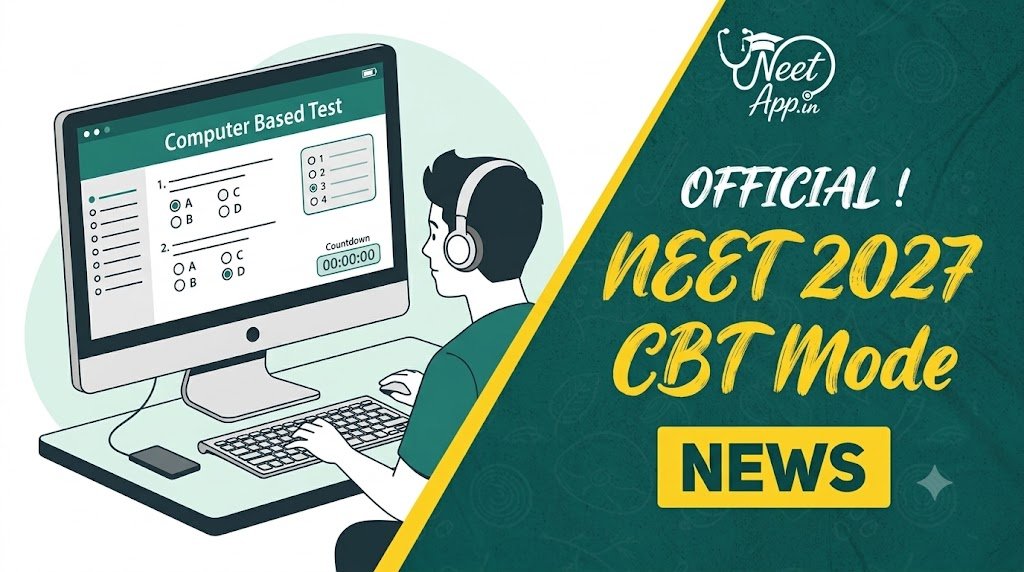
Official NTA Update: The Shift from Pen & Paper to Screen
The National Testing Agency (NTA) is preparing for a monumental transition in how India’s largest medical entrance exam is administered. The National Eligibility cum Entrance Test (NEET) is officially leaving behind its traditional pen-and-paper roots. For millions of NEET 2027 aspirants, the upcoming exam will be an online computer-based test.
Why is NEET Moving to an Online CBT Format?
The decision to conduct NEET UG in CBT mode comes after extensive discussions involving the Education Minister Dharmendra Pradhan and high-level committees tasked with reform. Administering a single-day exam for over 2 million candidates using physical sheets has created massive logistical vulnerabilities. Moving the NEET exam to an online mode aligns it with other premier national exams like JEE Main and CUET.
Eliminating Paper Leaks and Enhancing Security
The ultimate goal of this structural shift to CBT mode is ensuring total exam integrity. By delivering encrypted question papers directly to an audited exam centre terminal seconds before the test begins, the risk of a local paper leak is virtually eliminated. This change restores trust in the exam process and guarantees a level playing field for every single aspirant.
Major Structural Changes Coming in NEET 2027
A shift to a computer-based test means the entire blueprint of the exam day will look different compared to NEET 2026 or NEET 2025.
The 5 to 6-Day Testing Window Explained
Because it is impossible to host millions of students simultaneously on computers, NEET 2027 will be conducted across a window of 5 to 6 days. The exam will be conducted in multiple shifts, meaning different batches of students will write the test at different times.
Multiple Shifts and the Normalization Process
When a medical entrance exam is conducted in multiple shifts, each shift receives a unique question paper. To ensure absolute fairness, the NTA is expected to implement a percentile-based normalization formula, mirroring the system used in JEE Main. This ensures that if your specific shift features a harder physics or biology section, your final score is adjusted relative to your peers, eliminating any unfair disadvantage.
OMR vs. CBT: How the Exam Experience Will Change
Transitioning from a traditional pen-and-paper format to an online exam changes how you interact with the questions. Understanding the cbt interface is vital to avoiding anxiety.
Flexibility to Change Answers
In the old offline mode, bubbling the wrong circle on a neet omr sheet meant a permanent loss of marks. There was no way to erase ink. In the cbt format, you take the exam through a computer, giving you the freedom to click a different option if you realize you made a mistake.
The “Mark for Review” Feature
The cbt mode means you gain access to digital navigation tools. If a complex question in the 11 and 12 physics portion takes too long, you can select “Mark for Review.” This changes the question’s color on your sidebar dashboard, reminding you to revisit them later without hunting through pages of a booklet.
Precision Timing and Automated Evaluation
An on-screen countdown timer ensures you always know exactly how many minutes remain. Furthermore, because there is no physical omr sheet to scan manually, the evaluation process becomes instant and completely error-free.
What Will NOT Change in NEET 2027?
While the exam mode is shifting to a digital display, the core academic parameters of the latest neet framework are expected to remain completely untouched.
| Feature | Old Format (OMR) | New Format (CBT) |
| Syllabus | NCERT Class 11 & 12 | NCERT Class 11 & 12 |
| Total Questions | 180 Questions (to attempt out of 200) | 180 Questions (to attempt out of 200) |
| Marking Scheme | +4 for Correct / -1 for Incorrect | +4 for Correct / -1 for Incorrect |
| Rough Work | Margins of the booklet | Physical scratch pads provided |
The neet exam pattern and the core syllabus are not changing. You will still face the same conceptual depth across physics, chemistry, and biology. The NTA is expected to conduct the test with the exact same weightage split you are already practicing for.
How Aspirants Should Adapt Their Preparation Now
If you are a student in class 11 or one of the many neet repeaters aiming for the 2027 exam, you must modify your NEET 2027 preparation strategy immediately.
-
Ditch Paper Mock Tests: Stop relying solely on printed test papers. To succeed, you must practice inside a real exam environment using an online test series.
-
Build Screen Stamina: Sitting in front of a screen for over three hours solving intense problems requires mental conditioning. Start taking regular, full-length mock tests on a computer.
-
Master Digital Scratch Work: Since you cannot write directly on the question paper anymore, practice doing all your rough work neatly on separate sheets of paper while keeping your eyes fixed on a monitor.
Do not wait for the official notification brochure to arrive late in 2026 to change your habits. Adapting your routine to a digital workflow early is what will differentiate successful candidates from the rest.
Frequently Asked Questions (FAQs) About NEET 2027 CBT
Q: Will the question paper be harder because of the shift to CBT?
A: No. The NEET 2027 computer-based test is simply a change in delivery mode, not an increase in syllabus difficulty. The questions will continue to evaluate NCERT concepts.
Q: How will normalization work if my shift has a difficult paper?
A: NTA will use a normalized percentile ranking score. This ensures your rank is determined by how well you performed compared to others who wrote the exact same question paper as you.
Q: Will we get paper for rough calculations during the online exam?
A: Yes. Just like in JEE, every student at the exam centre will be provided with physical scratch paper for solving numericals, which must be turned in at the end of the shift.
Please review this full semantic draft carefully. Once you approve, let me know, and we will move to Step 4: Meta Data & Publishing Hand-off!