Table of Contents
Welcome to the foundation of Physics for your NEET prep! Before we can measure the universe, we have to agree on the fundamental rules of measurement. Every physical quantity is simply a number accompanied by a unit. Think of it like a language—before we can write complex sentences, we need to understand our alphabet.
Physical Quantities: Fundamental vs. Derived
In physics, all measurable quantities fall into one of two categories:
- Fundamental Quantities: These are the basic, independent building blocks of measurement, such as length, mass, and time.
- Derived Quantities: These are the “words” built from our fundamental alphabet. They are combinations of base blocks, creating quantities like velocity, acceleration, or force.
Historical Systems of Units to the Modern SI System
Historically, the scientific community was completely divided on how to measure the world. Different regions relied on entirely different classic measurement systems:
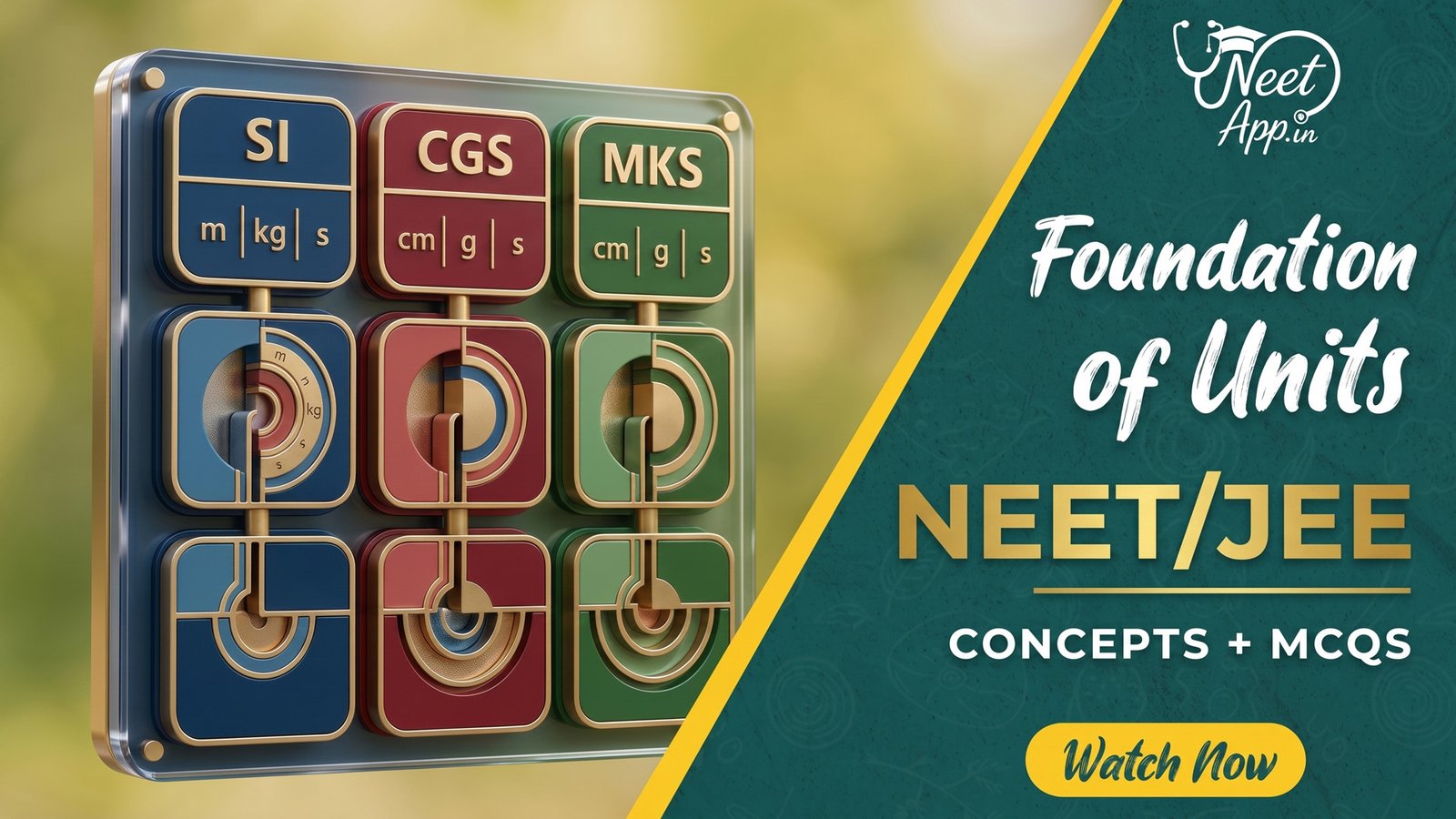
- CGS System: Measured in centimetres, grams, and seconds.
- FPS System: The British system utilizing feet, pounds, and seconds.
- MKS System: Measured in metres, kilograms, and seconds.
To end the chaos and standardise global science, the world united in 1960 to establish the modern international standard: the SI System (Système International d’Unités).
The SI system is built strictly upon seven base quantities:
- Length (metre)
- Mass (kilogram)
- Time (second)
- Electric Current (ampere)
- Thermodynamic Temperature (kelvin)
- Amount of Substance (mole)
- Luminous Intensity (candela)
The Dimensionless Exception: Supplementary Units (Radian & Steradian)
The NTA loves to test exceptions on the NEET exam! In addition to the seven base quantities, there are two extra quantities known as Supplementary Units, specifically used for geometric angles:
- Plane Angle ($\theta$): Measured in radians.
- Solid Angle ($\Omega$): Measured in steradians.
High-Yield NEET Trap: Both the radian and steradian possess highly defined SI units, but they are completely dimensionless quantities (possessing dimensions of $M^0L^0T^0$). This happens because they are defined as ratios of similar quantities (like arc length divided by radius length), causing the dimensions to completely cancel out.
Strict NCERT Guidelines for Writing SI Units (The Grammar of Physics)
If you want to survive tricky assertion-reason questions, you must memorize the “Grammar of Physics”. Here are the strict NCERT spelling and notation rules:
Capitalization Rules and The Litre Exception
- When writing a unit named after a scientist, the full word is never capitalized. You must write “newton” or “joule” in all lowercase.
- However, the symbol for a scientist’s unit is capitalized (e.g., N for newton, J for joule, A for ampere).
- For standard units not named after a scientist, both the full word and the symbol remain lowercase (e.g., metre and m).
- The Exception: The single major exception is the litre. It uses a capital L so it does not get visually confused with the Arabic numeral 1.
Plurals and Punctuation Rules
- Unit symbols are completely unaltered in plural form. Writing 25 cms is strictly incorrect; it must be written as 25 cm.
- Unit symbols never get a full stop or punctuation mark at the end.
The Solidus (Slash) Limitation
- You are only permitted to use one solidus (slash) in a compound unit.
- Writing Joules per kelvin per mole with two slashes (J/K/mol) is absolutely banned.
- It must be written cleanly as J/K mol or $\text{J K}^{-1}\text{mol}^{-1}$.
The Make-or-Break Spacing Trap
- Spacing changes physical reality!
- Writing $\text{m s}^{-1}$ (with a space) keeps the symbols independent, meaning “metre per second”.
- Removing the space to write $\text{ms}^{-1}$ mathematically binds the “m” directly to the second, morphing it into a prefix and changing the entire unit to “per millisecond”.
Prefix Rules and the Mass Anomaly
- Prefixes (like mega or nano) must stick directly to the unit without spaces.
- Double prefixes are completely illegal (e.g., you say one nanometre, never one milli-micrometre).
- The Mass Anomaly: The SI base unit for mass is the kilogram, meaning it already has the prefix “kilo” built right in. You can never stack prefixes. Therefore, $10^{-6} \text{ kg}$ is formed by attaching prefixes to the base word “gram”—making it 1 milligram (1 mg), not 1 micro-kilogram.
Test Your Knowledge: NEET MCQs on Unit Conventions
Question 1: The Dimensionless Unit Exception Plane angle and solid angle are classified as supplementary units. Which of the following statements is correct regarding their physical nature?
- They are derived quantities having both units and dimensions.
- They are fundamental quantities having dimensions but no units.
- They are supplementary quantities having units but no dimensions.
- They are base quantities having neither units nor dimensions.
Question 2: The Scientist Capitalization Rule Identify the option that completely satisfies the strict NCERT spelling and capitalization guidelines for writing SI units:
- The gravitational force acting on the block is 50 Newtons.
- The kinetic energy of the moving particle is 25 joules (Symbol: J).
- The current flowing in the circuit is 5 a.
- The distance between two points is measured as 3 Metres (Symbol: M).
Question 3: The Solidus (Slash) Limitation According to NCERT Appendix A8, which of the following compound unit representations is strictly illegal?
- $\text{m/s}^2$
- J/K mol
- J/K/mol
- $\text{m s}^{-2}$
Question 4: The Spacing Trap A student writes two symbols on a test paper: (I) “$\text{m s}^{-1}$” (with a space) and (II) “$\text{ms}^{-1}$” (without a space). What do these two expressions represent?
- (I) and (II) both represent the derived unit “metre per second”.
- (I) and (II) both represent the prefixed unit “per millisecond”.
- (I) represents “metre per second”, while (II) represents “per millisecond”.
- (I) represents “per millisecond”, while (II) represents “metre per second”.
Question 5: The Mass Prefix Anomaly To avoid stacking prefixes, how must a mass value of $10^{-6} \text{ kg}$ be represented in the SI system?
- 1 micro-kilogram
- 1 milligram
- 1000 micro-grams
- 1 microgram
Solutions
Solution 1: Option (3) is correct. Radian and steradian are the rare exceptions in physics that possess highly defined SI units but remain completely dimensionless ($M^0L^0T^0$).
Solution 2: Option (2) is correct. For a unit named after a scientist, the full word must be completely lowercase (joules), and the standalone symbol must be capitalized (J).
Solution 3: Option (3) is correct. NCERT guidelines expressly forbid the use of more than one solidus (slash) in a compound unit. It cannot be written as J/K/mol.
Solution 4: Option (3) is correct. The physical space keeps “metre” and “per second” separated. When the space is removed, the “m” binds directly to the second, turning it into the prefix “milli” (per millisecond).
Solution 5: Option (2) is correct. You cannot stack prefixes onto “kilogram”. By doing the conversion math ($10^{-6} \times 10^3 \text{ g} = 10^{-3} \text{ g}$), we find that it mathematically equals 1 milligram (1 mg).
Want a deeper dive into Unit Conventions? Watch our full visual breakdown here!
Make sure to subscribe to the channel for more high-yield NEET Physics content!